
Position of the Memories and Knowledge
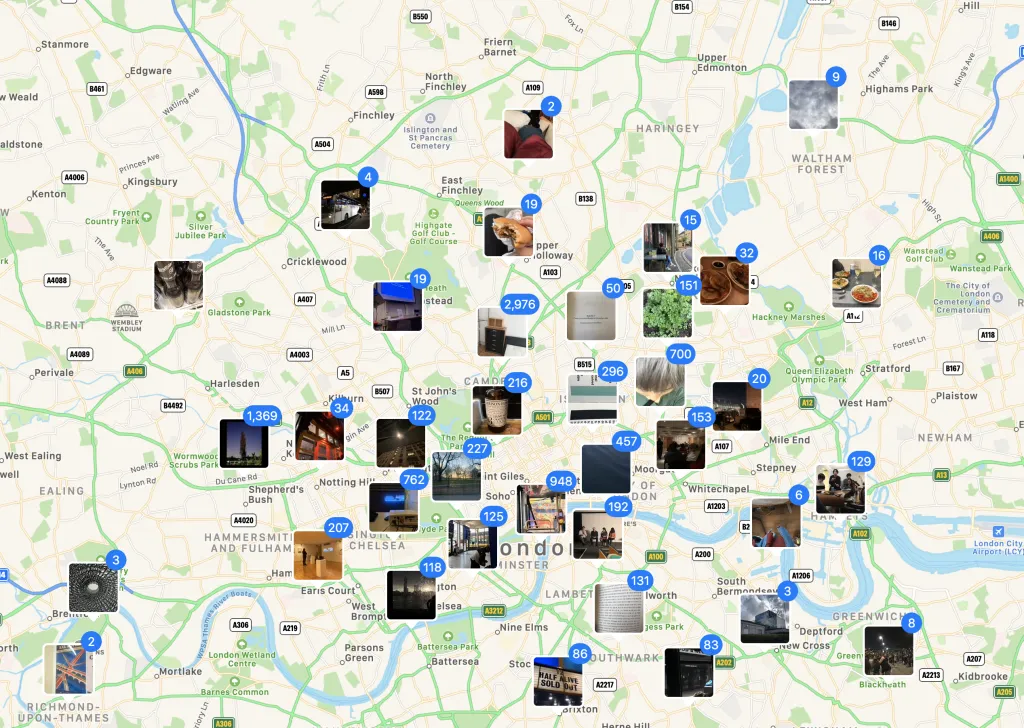
What is the purpose of the archive? Depending on the profession, the situation, or even the device, it can vary greatly. Most of the time, especially with my phone, I take photos to preserve a moment, to document that I was there, or to keep something as a reference for later. Where is it mostly? In this case, the iPhone’s GPS—specifically its ‘Places’ function—is quite efficient in showing where I have taken most of my photos. While it does not reveal the purpose of each image, it at least indicates where I have spent the most time. When I checked my photos again using the ‘Places’ feature, I realised that there were two locations where I had taken the most pictures: Camden and White City. Over two years, I captured almost 3,000 photos in the Camden area, whereas in White City, I took around 1,400 photos in just six months. If we consider memory as a montage of images at certain moments, then perhaps these GPS-tagged images can represent my experiences in a specific area, regardless of their original intent.
How can I describe this memory? Although each photo carries a slight subjective meaning, the majority are anchored by GPS data generated by the software. Can this collective data be considered knowledge? What distinguishes knowledge from memory?
Idea
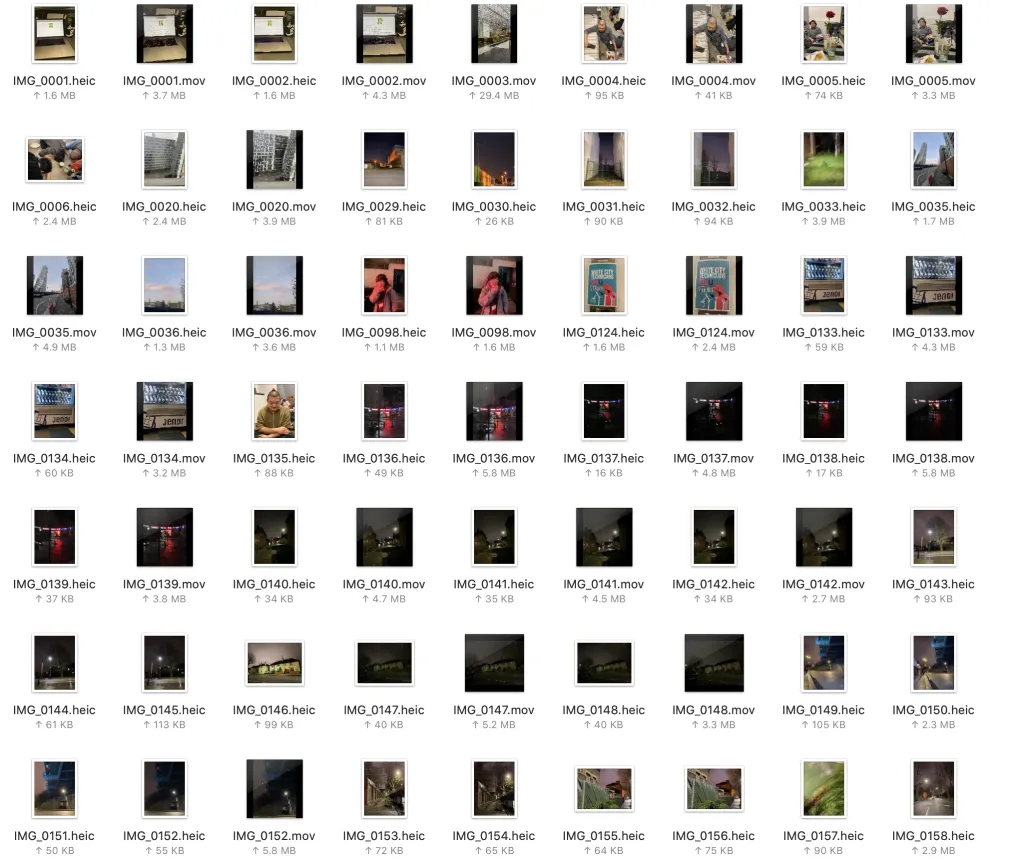
- Photo and Video together
- Composition
- Can it be Live? (Maybe through Instagram? ➡︎ Is that possible to upload images automatically by location?)
- Architectural Memory? Is that space?
For many years, historians have prioritised the study of long durations rather than isolated events, focusing on the gradual accumulation of historical developments and the deep structures that underlie them. As Foucault states, historians have turned their attention to “the movements of accumulation and slow saturation, the great silent, motionless bases that traditional history has covered with a thick layer of events” (Foucault, 2013, p. 3).
Historical descriptions are continuously reshaped by the present state of knowledge, revealing multiple pasts, different connections, hierarchies of importance, and alternative teleologies within a single field of study. Foucault highlights this ongoing transformation: “Historical descriptions are necessarily ordered by the present state of knowledge, they increase with every transformation and never cease, in turn, to break with themselves” (Foucault, 2013, p. 5). The most radical discontinuities occur when theoretical shifts detach a field from its ideological past, exposing that past as ideological. As Althusser notes, this process “establishes a science by detaching it from the ideology of its past and by revealing this past as ideological” (Foucault, 2013, p. 5).
The study of thought, knowledge, philosophy, and literature increasingly seeks out discontinuities, whereas history itself has shifted towards an emphasis on stable structures rather than the sudden eruption of events. Foucault observes that “the history of thought, of knowledge, of philosophy, of literature seems to be seeking, and discovering, more and more discontinuities, whereas history itself appears to be abandoning the irruption of events in favour of stable structures” (Foucault, 2013, p. 6).
Historians have traditionally questioned not only the meaning of documents but also their truthfulness, legitimacy, and whether they were produced with sincerity or manipulation. They have examined whether documents were well-informed or based on ignorance, whether they were authentic or tampered with. Foucault describes this as an inquiry into “whether they were sincere or deliberately misleading, well informed or ignorant, authentic or tampered with” (Foucault, 2013, p. 7). Traditionally, documents were treated as “the language of a voice since reduced to silence, its fragile, but possibly decipherable trace” (Foucault, 2013, p. 7). However, history is not simply an interpretation of texts, but rather the labour applied to material documentation—books, texts, registers, institutions, laws, techniques, objects, or customs—which exist in all societies, either spontaneously or in an organised form.
The role of history has shifted significantly. Traditionally, it sought to preserve the monuments of the past by converting them into documents. Today, however, history reverses this process, transforming documents into monuments. Foucault articulates this shift: “History, in its traditional form, undertook to ‘memorise’ the monuments of the past, transform them into documents; in our time, history is that which transforms documents into monuments” (Foucault, 2013, p. 8).
This transformation has resulted in several key consequences. First, discontinuities have proliferated in the history of ideas, and long durations have gained prominence over short-term events. The objective is no longer to position elements within a pre-existing sequence, but rather to establish distinct series, define their specific elements, set boundaries, and identify the relationships unique to each series. As Foucault explains, “The problem now is to constitute series: to define the elements proper to each series, to fix its boundaries, to reveal its own specific type of relations” (Foucault, 2013, p. 9).
Discontinuity, once regarded as a problem to be resolved, has now become central to historical inquiry. Previously, it was seen as “the stigma of temporal dislocation that it was the historian’s task to remove from history”, but today, “it has now become one of the basic elements of historical analysis” (Foucault, 2013, p. 10).
The emergence of a general history has replaced the former ambition for a total history. Rather than striving for a comprehensive, unified narrative, contemporary historiography acknowledges multiple perspectives and fragmented accounts. As Foucault notes, “Total history begins to disappear, and we see the emergence of something very different that might be called a general history” (Foucault, 2013, p. 11).
This transformation has also introduced several methodological challenges, many of which predate modern historical approaches but have now become defining characteristics of the discipline. These concerns are now integral to the methodological field of history. Firstly, history has largely freed itself from the concerns of traditional philosophy of history, including questions about the rationality of historical development, the role of teleology, and the relativity of historical knowledge. Foucault points out that history has distanced itself “from what constituted, not so long ago, the philosophy of history, and from the questions that it posed on the rationality or teleology of historical development” (Foucault, 2013, p. 12). Secondly, history now intersects with similar methodological problems found in other disciplines—including linguistics, ethnology, economics, literary analysis, and mythology—demonstrating how far historical inquiry has evolved beyond its classical form.
Foucault, Michel, ‘Introduction’, in Archaeology of Knowledge (Hoboken: Taylor and Francis, 2013), pp. 3–19